
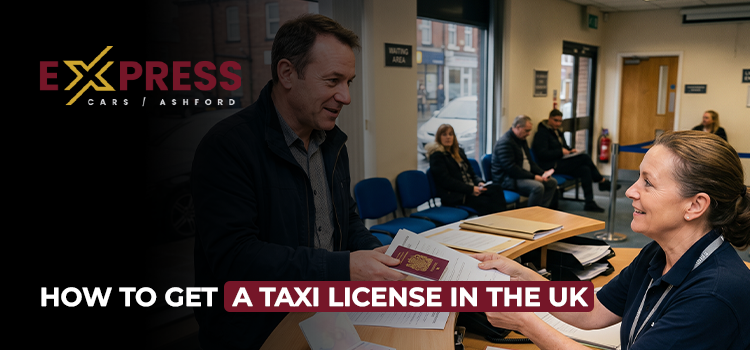
Most people picture the driving part and forget how much paperwork sits in front of it. Getting a taxi licence UK-wide involves eligibility checks, a medical, a knowledge test, and an application to your local council or TfL. It is also important to keep in mind that whether you end up driving independently or under an operator’s taxi service, the licensing steps stay the same.
This guide walks through the full process for both a private hire licence and a hackney carriage badge, plus the costs, timelines and requirements most articles gloss over. By the end, you’ll know exactly what your council or TfL expects before you submit anything.
Steps to Getting a Taxi License in the UK
Every taxi driving licence application follows roughly the same sequence, whichever authority you’re applying through. Here’s what actually happens once you break the process down.
Confirm Your Taxi License Eligibility
Taxi license eligibility starts with the right to work legally in the UK and that’s non-negotiable everywhere. You’ll also need to have held a full British, Northern Ireland or EU driving licence for at least 12 months.
Councils also run a “fit and proper person” check, which looks at your background and character rather than just your driving record. London drivers face one extra rule: you must be over 21 to apply for a taxi driving licence there. GOV.UK’s guidance on driver licences for taxis and private hire vehicles covers the exact eligibility wording each authority works from, and it’s worth reading before you assume you qualify.
- Right to work in the UK
- Full driving licence held for 12+ months
- Clean background suitable for a “fit and proper person” assessment
- Over 21 if applying in London
Meet the Taxi Driver Medical Requirements
A medical isn’t optional for either a taxi licence or a private hire vehicle licence. Your GP or an approved medical examiner completes a form covering eyesight, heart health and any condition that could affect safe driving.
Taxi driver medical requirements are broadly similar across councils, though a handful ask for a slightly different form or a specific practitioner. It’s worth checking your council’s exact paperwork before booking the appointment, since a mismatched form usually means booking again.
Pass an Enhanced DBS Background Check
Every applicant goes through an enhanced Disclosure and Barring Service (DBS) check as part of the fit and proper person process. This flags any convictions or cautions your licensing authority needs to weigh up before approving you.
A conviction doesn’t automatically rule you out but it does slow things down while the council reviews your case. Getting this check started early is one of the simplest ways to shorten the overall wait.
Sit the Knowledge Test Exam
Not every area requires one, but where a knowledge test exam applies, most famously for London’s black cab trade, it’s the part that catches people out. You’re tested on routes, landmarks and local geography rather than the Highway Code.
Private hire licence applicants outside London usually face a lighter version, sometimes just covering safeguarding and local awareness rather than full route memorisation. Drivers who build up strong local knowledge here often find it useful later too, since it’s the same skill that benefits them when offering regular school runs, corporate travel and high-end chauffeur services.
Complete a Driving Assessment
Alongside your existing full licence, most authorities ask for a short driving assessment geared toward taxi or private hire work. It’s less about basic competence and more about passenger comfort, awareness and handling a vehicle you might not usually drive.
This step tends to be quick once booked but availability can run weeks out in busier areas. Booking it alongside your medical saves a second round of waiting.
Budget for the Taxi Licence Cost
Taxi licence cost varies by council, but expect application fees, DBS charges and medical fees to add up to roughly £300–£600 in total before you’ve earned a penny. London’s route tends to sit toward the higher end once every fee is included.
- Application/badge fee (council-set, varies widely)
- Enhanced DBS check
- Medical examination fee
- Knowledge test fee, where applicable
- Vehicle and operator licensing, if not already held
How to Apply for a Taxi Licence
Once eligibility, medical and testing are sorted, the application itself is fairly mechanical. Here’s the sequence most councils follow, and TfL’s process runs close to the same shape.
Choose the right licensing authority.
Apply for a cab driving licence through your local council if you’re working outside London, or through TfL if you’re driving in the capital. You can’t mix and match. The driver, vehicle and operator all need licensing by the same authority. London applicants specifically should also get familiar with the PCO vehicle licence requirement, since it applies to the vehicle alongside your personal driver’s badge.
Gather your documents.
This typically means proof of identity, your driving licence, medical form, DBS result and proof of your right to work. Incomplete submissions are the most common reason applications stall.
Submit and pay.
Most authorities now accept applications online, with fees paid at submission rather than afterward. Keep your reference number as you’ll need it for any follow-up queries.
Wait for processing and collect your badge.
Processing times range from a few weeks to a few months, depending on the authority’s backlog. Once approved, you’ll be issued your taxi driving licence, typically valid for three years before renewal.
Conclusion
Getting a taxi licence in the UK comes down to a fixed roadmap: confirm eligibility, pass the medical, clear an enhanced DBS check, and sit the knowledge test where it applies. Budget £300–£600 for the combined fees, and book the medical and DBS early to keep things moving.
The application itself is straightforward once that groundwork is done. Pick the right authority, submit your documents and pay the fee. Whether you’re going independent or joining an operator’s fleet, the same licence applies, valid for three years before renewal.
Frequently Asked Questions
How much does it cost to get a taxi licence in the UK?
Costs vary by council, but most applicants pay somewhere between £300 and £600 once application fees, DBS checks and medical exams are all accounted for.
Is a standard driving licence enough to drive a taxi?
No. You need a full driving licence held for at least 12 months, plus a separate taxi or private hire licence issued by your local authority or TfL.
When are you eligible to apply for a UK taxi licence?
You can apply once you meet the right-to-work, driving licence and background check criteria, and in London, once you’re over 21.
How long is a UK taxi licence valid before renewal?
Licences are typically valid for three years, after which you’ll need to renew through the same authority that issued the original.
How long does it take to get a taxi licence in the UK?
Timelines vary by council, but most applicants should expect the full process, including medical, DBS, testing, and processing to take somewhere between six and twelve weeks.